
Getting Started#

Tell me where you're from and what you can do, and I'll tell you where you sleep tonight.
It is 1512 After the War of Souls. The nine pieces of the Everspark sit in the nine great cities of Sedia, and humans, the newest race, are slowly breeding out the older ones. Somewhere in all of that is your character. This page puts them on paper, one section of the character sheet at a time.
The Plains of Sedia video game walks you through all of this on its own. At the table you do it by hand: print the sheet, grab a pencil, and work down the steps. The order isn’t a rule, it just saves you from erasing.
Download the character sheet (PDF)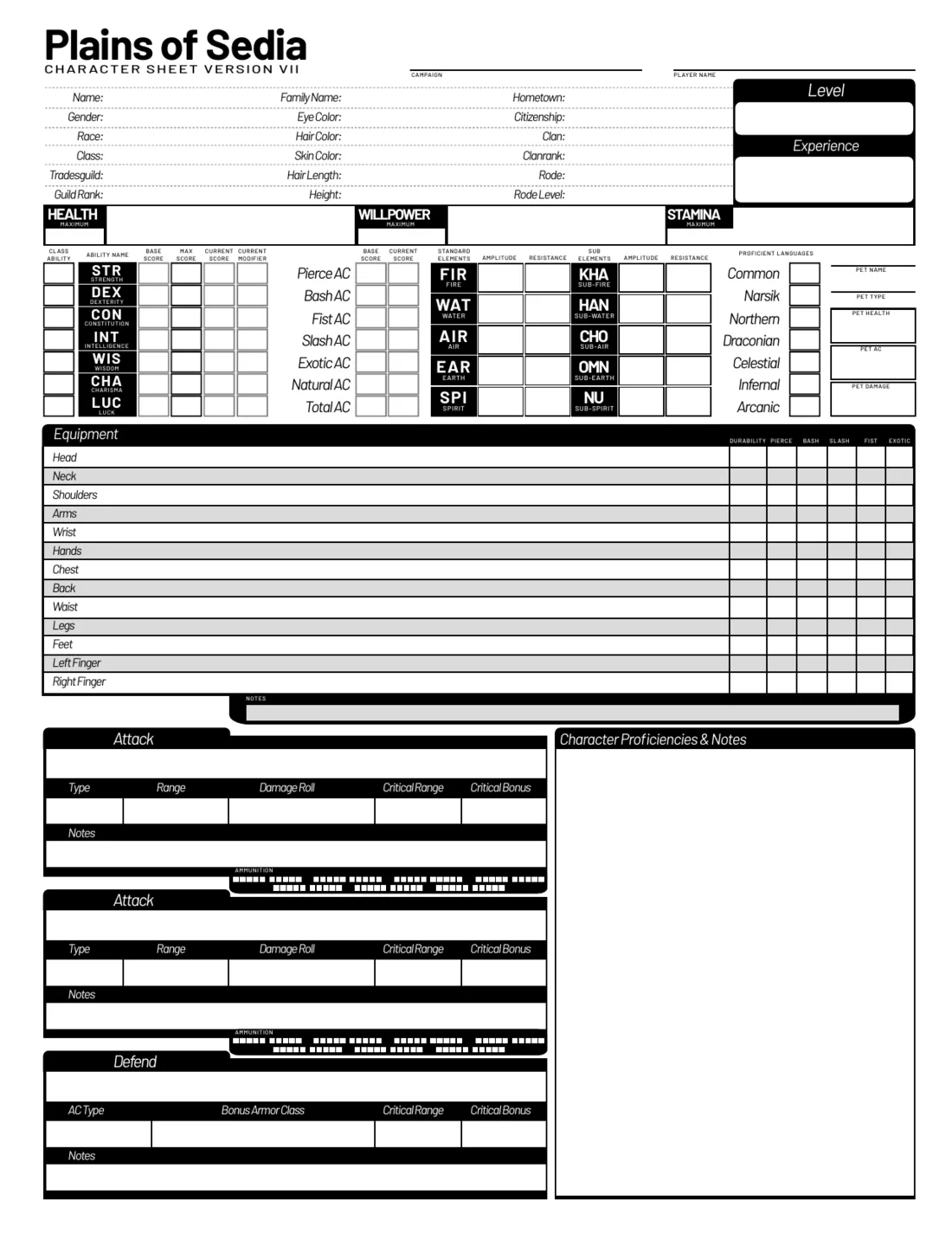
Who you are#
Start with your race. It decides more of the sheet than anything else: your starting ability scores, your natural armor class, which genders it has, and how tall and heavy you can be. Write it in Race.
Each card shows the race’s two highest starting stats and its natural armor class.


Then name them. Most people in Sedia carry one name, and a family name if they have one (the charter of their city approves it). Skip the middle name: those belong to royalty, and commoners caught with one get scorned or worse. If nothing comes to mind, Names has your race’s naming customs and a d20 table to roll one.
Fill in the appearance column (gender, eye color, hair color, skin color, hair length and height), keeping gender and height inside what your race page allows.
Your class#
A class is less a job than a record of what your character has lived through, and the classes are suggestions more than restraints. Still, it decides your two strongest abilities, your proficiencies and languages, and every ability you’ll learn. Write it in Class.
 Elementalist
Battle mages whose magic comes to them unasked, in fear and fury, and hits harder than a mage's with far less control.
 Gravedigger
Necromancers who start with a shovel.
 Headhunter
Mercenary captains: the best fighters money can hire, and the only ones who come with a crew.
 Hermit
Seekers who leave everyone behind to find what holds magic together.
 Mageling
Students of the Mage Spire who see the weaves as colored threads and lay them one on another with a trained will.
 Minstrel
Singers and blade dancers who work magic through celestial tunes, an art lost for ages and found again only in the Age of Man.
 Monk
Peaceful warriors who fight without weapons and would rather not fight at all.
 Page
Knights in the making, whose job is to be hit in someone else's place.
 Pickpocket
Thieves, rogues and assassins, quick with their hands and quicker to leave.
 Plainsman
Barbarians of the open plains who fight with rage and distrust magic on principle.
 Priest
Healers and keepers of the faith in an age when all three gods are missing.
 Runescribe
Rune-singers who work the tiny, quick seams between the threads, the way the draconians of a forgotten age did.
 Scout
Monks who took up the blade: fast, light fighters who chain weapon strikes into finishers the way monks chain blows.
 Woodsman
Hunters, trackers and druids who need nothing from civilization.
Your ability scores#
Every ability on the sheet has a row of boxes. Fill them left to right:
- Class Ability. Write a 5 beside your class’s primary stat and a 3 beside its secondary (support) stat. Leave the rest empty. Use the stats on the class page; the primary and secondary stats a race page lists don’t go here.
- Base Score. Your race’s starting stat.
- Max Score. Base score plus 5, plus class ability. This is as high as the ability can go. Leveling gives you training points that raise current scores toward it (Levels).
- Current Score. The same as your base score, for now.
- Current Modifier. Current score divided by 4, rounded down. A 15 gives a modifier of 3.
| Score | 4-7 | 8-11 | 12-15 | 16-19 | 20-23 |
|---|---|---|---|---|---|
| Modifier | 1 | 2 | 3 | 4 | 5 |
Last, write your race’s natural armor class in the Natural AC row.
Level and pools#
Write 1 in Level and 0 in Experience. Every character starts with 100 health, 100 willpower and 100 stamina, whatever their race and class: write 100 under each Maximum, and keep the pool itself in pencil beside it, since it’s the number that changes most. Each level adds to all three (Levels), and The Basics has how they come back.
Worked example: a dwarf page#
Take a dwarf page out of Jewall. Pages lead with constitution and back it with strength, so CON gets the 5 and STR gets the 3.
| Ability | Class | Base | Max | Current | Modifier |
|---|---|---|---|---|---|
| STR | 3 | 12 | 20 | 12 | 3 |
| DEX | 8 | 13 | 8 | 2 | |
| CON | 5 | 12 | 22 | 12 | 3 |
| INT | 9 | 14 | 9 | 2 | |
| WIS | 11 | 16 | 11 | 2 | |
| CHA | 9 | 14 | 9 | 2 | |
| LUC | 9 | 14 | 9 | 2 |
Notice the class ability didn’t touch the modifier. A dwarf starts with CON 12 and a modifier of 3 whatever their class is. What being a page buys is room to grow: CON can climb to 22, where a class without it caps out at 17. Natural AC is 15, straight off the dwarf page.
What you know#
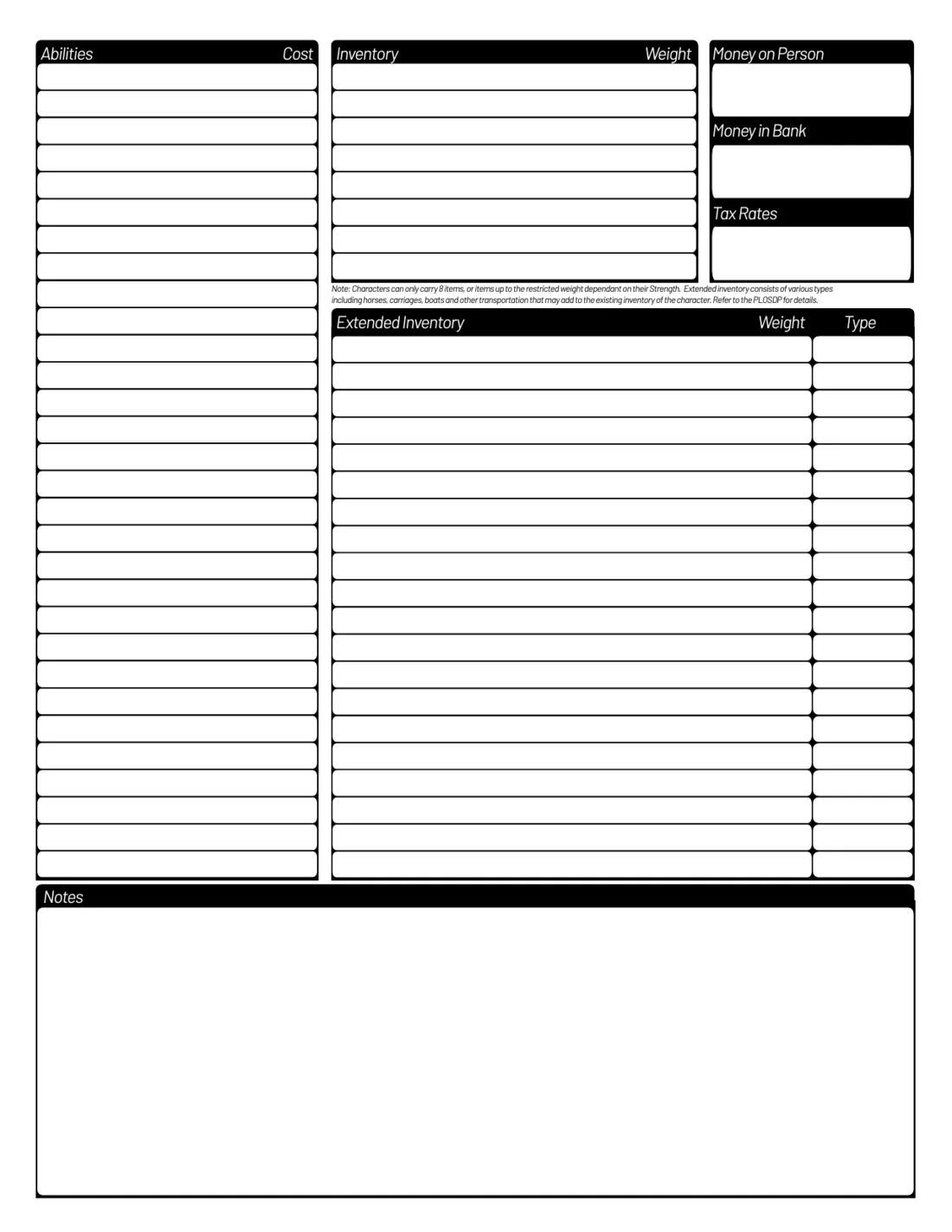
Your class decides what you’re trained in, and its page lists all of it. Copy its proficiencies (weapons, armor, extra attacks) into Character Proficiencies & Notes, check the languages it grants under Proficient Languages, and write its abilities with their cost in the Abilities column on the back.
| Class | Languages |
|---|---|
| Elementalist | Common, Celestial, Infernal, Arcanic |
| Gravedigger | Common, Infernal |
| Headhunter | Common, Narsik |
| Hermit | Common |
| Mageling | Common, Arcanic |
| Minstrel | Common |
| Monk | Common |
| Page | Common |
| Pickpocket | Common, Narsik |
| Plainsman | Common |
| Priest | Common, Celestial |
| Runescribe | Common, Draconian |
| Scout | Common |
| Woodsman | Common |
Where you come from#
Pick the province your character calls home and write it in Hometown. There are ten: nine across Sedia and Narsis under the ground. Home Province ranks them for your race and has what each rank costs and pays. You can enlist in your province’s army at any level; citizenship opens at level 20. If you’d like a past to go with the place, the upbringing roller rolls your family’s station and what you grew up around.


Each character can belong to two tradesguilds, which decide what you can craft and sell. Write yours under Tradesguild.
Leave Rode blank. A rode is a path of quests and trials that shapes how your character fights and looks, and you can’t start one until level 20.
What you carry#
Ask your storyteller
Two things here are up to the storyteller, not the rules: whether you start with any money, and which purchasing scheme the table uses.
Write any starting money in Money on Person on the back. Most tables start with open purchasing: find what you want in the item lists, pay the listed cost, and it’s yours, assumed bought before the story starts. Some storytellers add limits to keep a group balanced. Whatever you buy goes in Equipment if you’re wearing it and Inventory if you’re carrying it, and Items covers how much you can carry.
With your gear in hand, fill in the rest of the front:
- Equipment and the AC rows. Every piece of armor has an AC against pierce, bash, fist, slash and exotic damage. Write each piece’s numbers on its line and add each column into its row beside your scores. A tenth of a row is the share of that kind of damage your armor takes off a blow (Armor).
- Attack, a box for each weapon: its type, range, damage roll, critical range and critical bonus, from Weapons. Your attack roll is a d20, your Dexterity modifier and a tenth of your efficacy with the weapon (Attacking).
- Defend: your Defense, which is your natural AC, your Dexterity modifier and any guards you’ve learned (Defending).
- The elements. Leave the amplitude and resistance boxes empty until a material, a piece of gear or a spell gives you some (Materials).
- Clan and pet. Leave them for now. You can join a clan once you’ve met one, and a pet gets its name, health, AC and damage in the box on the right when you buy or tame one.
Your first session#
Bring the sheet, a pencil (current scores and money change constantly, so erase rather than cross out), a d20 and a few smaller dice, and a notebook for the maps, names and debts the sheet has no room for.
When you try something that could go wrong, the storyteller sets a DC and you roll a d20 plus the modifier of the score it leans on. The Basics has those checks, saving throws, every condition and how you get your health back.
When a fight breaks out, whoever started it goes first and everyone else rolls a d20 plus their Dexterity modifier for the order. Every attack is a d20 against the target’s Defense: a natural 20 always hits and a natural 1 always goes wrong. Combat walks through hitting, defending, damage and what it does to your gear. The storyteller hands out experience for the foes you beat and the things you get done, and Levels has what each level gives you.