Combat#
Combat Overview#
Combat is an integral part of Plains of Sedia, both in the video game and pen and paper roleplaying game. It’s important not only to understand how one participates in combat when you are a storyteller but how to coordinate a balanced system where the player is fighting enemies that he or she can fight appropriately without too much discouragement or strife. This section is dictated to explaining how one participates in battle, how the enemy responds in battle and the different requirements and features that take place therein. To start there are 4 main phases of a combat. When entering combat you roll for initiative to determine the order the characters take turns. When it’s a characters turn, they roll to hit a target. If they successfully hit the target they roll for damage. If the attack was blocked the attacker loses durability on their weapon. If they critically attack they lose durability on their weapon. If the target takes damage, they lose durability on the armor that was attacked. In order to compute much of this there is one prerequisite attribute found on all the items involved: Material Damage Type Amounts.

Material Damage Type Amounts#
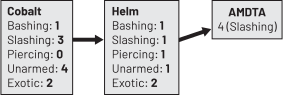
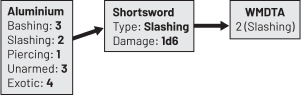
There are five different damaging types: Bashing, Slashing, Piercing, Unarmed and Exotic. All materials have an amount in each of these damage types indicating how proficient it is at handling or dealing different types of damage. These two variables are formally named: Armor Material Damage Type Amount (AMDTA) and Weapon Material Damage Type Amount (WMDTA).
Armor Material Damage Type Amount (AMDTA)#
Weapon Material Damage Type Amount (WMDTA)#
Roll For Initiative#
Before combat actually begins, all members need to roll for initiative. To compute an initiative roll you roll 1d20 and add the characters dexterity modifier. The order of the characters is based entirely on highest to lowest initiative roll.

Roll to Hit Target#
In order to hit the target, the player must add their current dexterity modifier, weapon MDTA, and 1d20. Note the biggest differential is the MDTA and the roll. This proves the importance of ensuring not only that your weapon has high MDTA, but that the weapons PMDTA was chosen wisely. (I.e. if the weapon is slashing, the MDTA for slashing is high.) If the wrong MDTA is high, it becomes a silly weapon that’s difficult to utilize in battle. Dex modifier contrasts never get too big, but can play a pivotal role in tipping the scales in close situations. Heroic and higher level areas and dungeons are scaled to accommodate high MDTA, therefor an extra 1 Dex effectively raises the chance to hit of equal MDTA by 5% at heroic level. Difficulties and generalities of balancing hit percentage are described in further detail in the next 2 following subsections. Note that a mobile is an enemy and is commonly referred as such to indicate an enemy in a video game that moves.
d20 Roleplayer Game#
The storytelling game computation of combat is slightly different than the video game to make it easier to do since there is no random number generator for decimal places. Obviously that could be used instead if there’s a supplemental calculator or number generator available.
• Attack Strength: Player Dexterity Modifier + Player WMDTA + 1d20
• Defense Strength: Enemy Dexterity Modifier + Enemy AMDTA
• Successful Attack: Attack Strength - Defense Strength > 0
• Dodged Attack: Non-successful Attack and (Player WMDTA - Enemy AMDTA > Player Dex - Enemy Dex)
• Blocked Attack: Non-successful Attack and Non-dodged Attack
Video Game#
The video game combat computations are slightly more complicated but produce more interesting and accurate results. The successful attacks are always the same as the non-video game computations, but the distribution of dodges versus blocks are more accurate. The differentials allow us to acquire a random number based on the weight of differences between dodge and block assuming both have a 50% chance. Because dodge values are usually much smaller than MDTA values, we have to turn them both into percentages to normalize the possibilities of it being each. Even though a dodge value could be enormously more possible than a block, it’s still slightly possible to have a block - in this way this method is preferred over the d20 roleplayer combat computations.
• Attack Strength: Player Dexterity Modifier + Player WMDTA + 1d20
• Defense Strength: Enemy Dexterity Modifier + Enemy AMDTA
• Successful Attack: Attack Strength - Defense Strength > 0
• MDTA Differential: Player WMDTA/(Player WMDTA+Enemy AMDTA)
• Dodge Differential: Player Dexterity Modifier / (Player Dex Mod+Enemy Dex Mod)
• Total Differential: MDTA Differential + Dodge Differential
• Dodged Attack: Non-successful Attack and Random number between 0 and Total Differential less than Dodge Differential
• Blocked Attack: Non-successful Attack and Non-dodged Attack
Critical Success & Critical Failure#
If the 1d20 roll equals a 1 then the attack is forfeited and considered a critical failure. Critical failures automatically append damage of the intended type onto the player itself, for example: Bobby tripped over his feet and stabbed himself in the belly for 1d8 damage. If the 1d20 hit roll equals a 20 it is considered a critical success. For information on critical success see its perspective section. Some weapons have a critical success range that is greater than 5%, make sure to refer to the actual weapon if one is equipped to inherit it’s critical strike range; unarmed or weapons that don’t declare a range are assumed to have a 5%. There are magical affects that reduce the chance for critical failure, please be sure to review any magical affects on armor and weapons closely before assuming you inherit the default percentages.
Material Damage Type Amount Analysis#
Material Damage Type Amounts (MDTA) scale to a maximum of 20 which is estimated to be the average for a level 100. No material damage type amounts should ever exceed 20. 0 is the average for a level 0 and the average ratio should gradually increase at a flat rate of 0.2 each level up to level 100 where it reaches its hard cap. The DC (Difficulty Check) modifier is the AMDTA minus the WMDTA.
Realistic Examples#
| DC | WMDTA | AMDTA | Hit Chance |
|---|---|---|---|
| 0 | 20 | 20 | -0% |
| -5 | 20 | 15 | +25% |
| 5 | 15 | 20 | -25% |
Edge-case Examples#
| DC | WMDTA | AMDTA | Hit Chance |
|---|---|---|---|
| -20 | 20 | 0 | +100% |
| -10 | 10 | 0 | +50% |
| 0 | 0 | 0 | -0% |
| +10 | 0 | 10 | -50% |
| +20 | 0 | 20 | -100% |
Dexterity Modifier Analysis#
The average dexterity modifier for a character is 0 (10 is the average dexterity and the modifier is the dexterity amount minus 10 divided by 2.) Characters can have dexterity modifiers up to 5 as a hard cap which would indicate the character has dexterity of 20-21. The DC Modifier is the enemy dexterity modifier minus the player dexterity modifier.
Realistic Examples#
| Player Dex Mod | Enemy Dex Mod | DC | Hit Chance |
|---|---|---|---|
| 5 (20-21) | 5 (20-21) | -0 | +0% |
| 5 (20-21) | 4 (18-19) | -1 | +5% |
| 4 (18-19) | 5 (20-21) | +1 | -5% |
Edge-case Examples#
| Player Dex Mod | Enemy Dex Mod | DC | Hit Chance |
|---|---|---|---|
| 5 (20-21) | -5 (0-1) | -10 | +50% |
| 0 (10-11) | -5 (0-1) | -5 | +25% |
| -5 (0-1) | -5 (0-1) | -0 | +0% |
| -5 (0-1) | 0 (10-11) | +5 | -25% |
| -5 (0-1) | 5 (20-21) | +10 | -50% |
Mobile Difficulty Check#
The Difficulty Check essentially represents how difficult that mobile is to the player. It is almost exclusively based upon the modifiers set in the hit percentage checks; however, there are DC modifiers that may be applied to this depending on if the mobile has any special skills or is traditionally scaled towards a higher difficulty anyways due to its hitpoints of skills being out of range. For more specific information on DC modifiers please refer to the generation of mobiles section.
| Experience Modifier | Difficulty Name | DC |
|---|---|---|
| 0% | Mundane | <0 |
| 50% | Very Easy | 0 |
| 75% | Easy | 1 |
| 100% | Average | 2 |
| 125% | Hard | 3 |
| 150% | Expert | 4 |
| 175% | Demanding | 5 |
| 200% | Challenging | 6 |
| 300% | Heroic | 7 |
| 400% | Painful | 8 |
| 500% | Torture | 9 |
| 1000% | Insane | >10 |
Durability#
Durability is reduced on critical strikes, on successful blocks, or when being struck with an armor piercing weapon. Once durability reaches or becomes lower than zero, than the item becomes destroyed. Destroyed items aren’t removed from the world, but remain unusable until they are repaired. A durability example: 25:99%. 25 represents the amount of durability points the item has, and 99% shows the strength of the item, where a 99 or higher needs to be rolled in order to reduce the durability points. If the attacker strikes and rolls a 100 then they will remove durability points. One point is reduced per durability reduction. The durability point for which that equipment is removed from depends on what was targeted. When attacking, the player may indicate they want to attack a certain part of the enemy’s body, and if they don’t, then they roll a d100 to randomize the part of the body that is attacked. There are some parts of the body that may have armor that won’t be attacked in this roll. These armor pieces are called supplementary armor class additions. SACA are helpful in increasing ones overall AC and ensure that if all of one’s armor is destroyed due to battle, there are at least a couple pieces that will remain to ensure the character isn’t completely defenseless.
| Roll | Equipment Name |
|---|---|
| 0-5% | Head |
| 6-12% | Shoulders |
| 13-18% | Arms |
| 19-22% | Wrist |
| 23-24% | Hands |
| 25-65% | Chest |
| 66-74% | Back |
| 75-87% | Waist |
| 88-98% | Legs |
| 99-100% | Feet |
Supplementary Armor Class Additions (SACA)#
Some armor cannot be targeted for attack and are merely used to supplement armor class.
- Neck
- Left Ring
- Right Ring
Roll to Damage Target#
One of the most integral parts of battle is dealing damage. It’s important to understand all the mechanics and parameters involved in battle as the characters life could hang on the outcome. After it’s been distinguished that the player is going to hit the target and that the target isn’t dodging or parrying the attack, we roll damage. You may also roll damage if the attack was deemed to be a critical failure. With standard attacks we add the craftsmanship modifier, the weapon damage, and magical identifiers, and then if it’s melee we add the current strength mod, ranged we add the current dexterity mod instead. Skills, magic, or other abilities may have special computations for damage; all of these are class-based except for non-sentient creatures. Non-sentient creatures are case-by-case at the storyteller’s discretion.
- Melee Attack: Strength Mod + Weapon Damage + Craft Mod + Magic Identifier(s)
- Ranged Attack: Dexterity Mod + Weapon Damage + Craft Mod + Magic Identifier(s)
- Ability Attack: Refer to the ability information located in the perspective class section
Craftsmanship & Attack Strength#
Craftsmanship of weapons can have a significant impact on the damage output of a character. As the craftsmanship increases, not only does the base damage increase, but critical strikes assist for greater spike damage, more evident on fine to masterwork crafts. Note that the biggest gap in damage falls on craftsmanship d4-d12 on basic weapon damage. It becomes negligible compared to low base+critical strike boosts. Prioritize weapons therefor by craft, magical identifications, and then the weapons damage. Note that weapons already have critical strike multipliers attributed to them, this craftsmanship damage multiplier compounds with that. If a masterwork halberd critical strikes (50% chance) it does the (1d12*1+8+14)x4 where 15 is the craftsmanship bonus, x4 is the damage multiplier, 1 is the halberds critical strike multiplier and 8 is the halberds critical strike bonus.
| Craftsmanship | Critical Strikes | Damage Multiplier |
|---|---|---|
| Trash | +0 | x2 |
| Crude | +1 | x2 |
| Shoddy | +2 | x2 |
| Poor | +3 | x2 |
| Inferior | +4 | x2 |
| Adequate | +5 | x2 |
| Acceptable | +6 | x2 |
| Average | +7 | x2 |
| Fine | +8 | x3 |
| Exceptional | +9 | x3 |
| Flawless | +10 | x3 |
| Masterwork | +15 | x4 |
Magical Affects#
Magical affects are shown on items as prefixes and suffixes called magical identifiers. It’s important to keep track of all magical identifiers that are equipped on your person during a storytelling session so that it is easier to add them when it’s necessary to do so during battle. For a list of all magical identifiers that can affect weapons or armor you can see its perspective section under Magic Identifiers.
Armor Class Craftsmanship#
Armor Class [AC] is the representation of how strong a piece of armor is, and how resistant that armor is against attacks. Furthermore, AC is the direction resistance against certain attack types. These attack types are referred to as base attack types, and quite simply are: Bash, Pierce, Slash, Fist and Exotic. A piece of armor may protect more against slashing weapons then it would piercing weapons. Basic Attack Type [AT] Resistances [BATR] is the AC version of Basic Attack Type Amounts [BATA] which is used for weapons, and similarly both weapons and armor have Material Damage Type Amounts [MDTA]. All three represent basically the same thing except from different perspectives. BATR is the defense strength to AT’s, BATA is the attack strength of AT and MDTA help distinguish the weapons viability and subsequent chance to hit the target. One benefit of tradesguilds is the ability to craft armor that has boosts in AC past the standard amounts one might see in generic armor. The quality of said crafted armor reflects the beneficial properties bestowed. The craft qualities range from Trash to Masterwork. Trash, Crude, Shoddy, Poor, and inferior actually reduce the amount of AC bestowed instead of increasing it like Acceptable, Average, Fine, Exceptional, Flawless, and Masterwork qualities. The adequate quality bestows no positive or negative properties, and is the middle of the qualities. It’s important to note that the AC increased due to quality of craftsmanship increases all the base attack type AC’s, such that an Acceptable item would add a 1 to bash, slash, pierce, fist, and exotic. In negative craftsmanship properties, the amount can never fall below zero per item. Armor class cannot be reduced below zero.
| Craftsmanship | Affect |
|---|---|
| Trash | -5AC Across |
| Crude | -4AC Across |
| Shoddy | -3AC Across |
| Poor | -2AC Across |
| Inferior | -1AC Across |
| Adequate | - |
| Acceptable | +1 AC Across |
| Average | +2 AC Across |
| Fine | +3 AC Across |
| Exceptional | +4 AC Across |
| Flawless | +5 AC Across |
| Masterwork | +5 AC Across & 1% Critical Immunity |