Blacksmithing#
Blacksmithing is the forming of metallic products. One starts by repairing items within blacksmithing, gaining knowledge in the processes gradually from inquirer to apprentice when learning how to start working at a forge while rebuilding items. After successfully repairing completely destroyed items the blacksmith can now start to craft items as a journeyman. After becoming a master of blacksmithing the blacksmith can greatly increase the finished quality of an item by annealing and swagging. After becoming an artisan the blacksmith can increase the potency of slashing and piercing weapons with the use of sharpen.
Skills#
| Skill | RequiredRank | Required Tools |
| recondition | inquirer | steel wool |
| recondition is used to fix minor problems in items, turning fair or excellent condition items into mint condition. | ||
| repair | hobbyist | blacksmith hammer, anvil |
| repair is used to fix major problems in items, turning damaged or mediocre condition items into fair condition items sothey can then be reconditioned to mint. | ||
| rebuild | apprentice | tongs, forge, hearth |
| rebuild is used to completely overhaul broken or ruined condition items into damaged condition items to they can be repaired and reconditioned back into pristine shape. | ||
| press bellows | apprentice | tuyere |
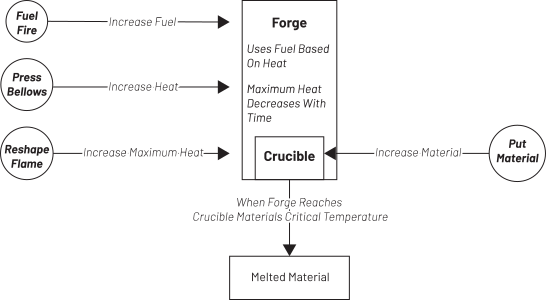
| increases the heat of the hearth or forge by forcing air into it (forge) or upon it (hearth) through a tuyere. | ||
| reshape flame | apprentice | coal |
| increases the maximum heat potential by assembling a new layer of damp coal around the edge of the earth or forge. | ||
| fuel fire | apprentice | coal |
| issues coal into a hearth or forge. | ||
| cast mold | journeyman | mold, crucible |
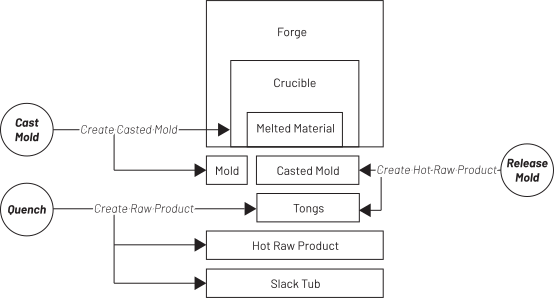
| use a present mold to cast an item of the molds type by pouring the melted material into it. | ||
| release mold | journeyman | mold, blacksmith hammer |
| after the melted metal cools into a solid, releasing a mold clears the hot raw product from the mold making it ready for quenching. the mold is destroyed during the process of releasing the product from the mold. | ||
| quench | journeyman | tongs, slack tub |
| done immediately after releasing a mold quenching dumps the hot raw product into a slack tub so it can be swagged. | ||
| anneal | master | tongs, forge, hearth |
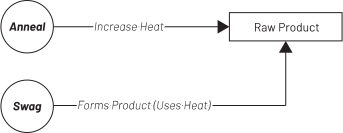
| annealing increases the heat of the raw prouct so swagging can occur. | ||
| swag | master | blacksmith hammer, anvil |
| swagging is cold-working of a material into its desired shape, increasing the outcome quality. swagging reduces raw products heat. | ||
| sharpen | artisan | whetstone, stropping stick |
| sharpen allows the use of a whetstone or stropping stick upon a slashing or piercing item to make it deal more damage during combat. | ||
| form mold | artisan | sand, forge, item |
| form mold allows the artisan blacksmith use a reference metallic item, sand and a forge to create a mold for which the blacksmith may use later for casting. | ||
Basics#
- Repairing
- Rebuild fixes severly damaged or broken items
- Repair fixes moderately damaged items
- Recondition fixes lightly damaged items
- Making an item
- Melt the ore in the crucible
- loading the crucible with an ore is done with put material
- If the ore isn’t melting, increase the temperature of the forge with fuel fire, press bellows or reshape flame.
- Pour the ore into a mold
- You can buy basic sand molds from your tradesguild or make them later on with form mold and a reference item to make a mold from.
- The mold won’t finish unless there is enough molten ore in the crucible
- Release the mold
- Once the mold has successfully been cast you can release mold to get a raw hot product
- quench the raw hot product
- At this point the item can be considered finished, but likely has a very low craftsmanship value
- continue with annealing and swagging to increase craftsmanship value
- anneal will slightly reduce the products craftsmanship value but increases its temperature
- Once the item is hot you can swag the item to form it better and increase the craftsmanship if successful
- Swagging also loses a small amount of the material on the item, losing too much material will destroy an item
- destroyed items are not fixable like broken items and can only be resmelted.
Detailed Stages#
The blacksmithing process involves three stages: Melting of Material, Creating a Raw Product and Forming The Finished Product. Material for melting can be acquired by salvaging existing metallic equipment or items. When salvaging equipment no material is lost in the process so an item that required 15 material to blacksmith will salvage into 15 salvaged material worth of parts. The three types of salvaged parts each have different material sizes with ingots being 5, components are 2 and fragments are the most atomic salvaged metallic part of 1 unit of material. Ingots may be created through the smelting process of raw ore or processed from melted material with an ingot mold. The blacksmithing process itself occurs within either a forge or hearth where a crucible is located within a forge while a crucible is placed atop a hearth.
Melting of Material#
The first phase starts with taking a source material and processing it into a melted form so it can be casted. In order to melt the material in the crucible the forge needs to be heated up to the materials particular critical point. The forge is heated up by pressing the bellows. The hotter the forge the more fuel it consumes. When the fuel depletes the forge will gradually decrease in heat until it reaches room temperature. Over time the maximum heat of the forge decreases as fuel is consumed so occasionally the blacksmith will need to have to reshape the flame.
Creating Raw Product#
The second phase begins with the crucible being poured into a mold. Provided the required amount of melted material is available in the crucible, the raw product begins to form within the mold as it cools. Using tongs the blacksmith will pull the hot raw product from the mold and then put it into the slack tub for quenching which rapidly cools the product and allows it to be formed manually through swagging in phase 3.
Forming Finished Product#
The final phase is where the blacksmith takes the raw product and forms it with a blacksmithing hammer against an anvil with a process called swagging. Swagging reduces the heat of the raw product rapidly, so occasionally the raw product needs to be pushed into the forge briefly to heat up in a process called annealing so that it can continue to be formed with swagging.
Materials#
| Name | Description |
|---|---|
| steel wool | a piece of steel wool allows a blacksmith to recondition armor or weapons to restore them to their pristine state. |
| whetstone | stone used to help sharpen a piercing or slashing weapon. |
| stropping stick | leather strip used to help sharpen a piercing or slashing weapon. |
| clay wire tool | the wire tool allows the sigildry tradesperson to cut a clay form from atop a pottery wheel so it can be moved to a kiln. |
| blacksmith hammer | specialized hammer used within the blacksmithing tradesguild to form weapons, armor and other items. |
| ingot mold | an ingot mold is used to cast molten purified ore into ingots so that blacksmiths can use the ingots for producing items. the process of purifying ore is through smelting it. |
| block mold | a block mold is used to cast molten purified ore into blocks so that blacksmiths can consolidate materials. a block is essentially 20 ingots in material amount. |
| crucible | a crucible is the heavy pot used to hold molten ores. a crucible is made of a metal with a high boiling point so that it is resistant to the potential heat. crucibles are generally built atop forges with a crankshaft used to tip the crucibles, and lift it to pour into molds. |
| slack tub | tub of cool water used to extinguish heat from hot metals after they’re done being cast. |
| forge | helps in heating of materials contained as ingots into molds by melting them into a liquid state. |
| hearth | very similar to a forge, a hearth is a smaller version where the crucible actually sets ontop instead of within. a hearth heats up to melt the material within the crucible. |
| anvil | an anvil is a very strong metal slab where armor and weapons are lain to be battered by a hammer into shape. |
| coal | coal fuels fire that heats a furnace or forge. |
| tuyere | item used to breathe air into a hearth or forge to increase the heat. |
| tongs | tongs are metallic tools that bend at the top apex, allowing the tips to clamp and surface with the continued force of squeezing the handles together. tongs are used to hold very hot items, predominately those that need to be transported to the quench tank to cool. |
Items#
| Name | DC | Required Mats |
|---|---|---|
| coif | 5 | 5 |
| helm | 6 | 6 |
| full helm | 8 | 8 |
| horned helm | 10 | 7 |
| skull cap | 6 | 6 |
| face guard | 7 | 5 |
| face plate | 7 | 5 |
| armet | 10 | 8 |
| barbute | 14 | 10 |
| bascinet | 13 | 11 |
| burgonet | 12 | 12 |
| sallet | 11 | 9 |
| hounskull | 13 | 12 |
| nasal helm | 10 | 8 |
| spangenhelm | 11 | 10 |
| full sallet | 10 | 18 |
| bevor | 13 | 14 |
| besagews | 17 | 7 |
| scaled shoulders | 8 | 24 |
| half-plate shoulders | 10 | 28 |
| plate shoulders | 10 | 31 |
| arm-guards | 8 | 6 |
| cuffs | 8 | 8 |
| bangle | 11 | 5 |
| ailettes | 16 | 8 |
| bracers | 8 | 7 |
| shackles | 11 | 8 |
| handguards | 12 | 12 |
| gauntlets | 10 | 11 |
| chainmail gauntlets | 10 | 10 |
| scalemail gauntlets | 10 | 14 |
| platemail gauntlets | 10 | 18 |
| platemail | 10 | 41 |
| ringmail | 11 | 38 |
| chain cuirass | 8 | 37 |
| half-plate | 12 | 40 |
| chestplate | 10 | 37 |
| scalemail | 10 | 35 |
| field plate | 8 | 42 |
| banded mail | 11 | 37 |
| girdle | 10 | 21 |
| fauld | 15 | 8 |
| chatelaine | 10 | 15 |
| cord | 10 | 8 |
| senguillere | 15 | 16 |
| poleyns | 15 | 21 |
| legguards | 11 | 16 |
| scale leggings | 12 | 19 |
| half-plate leggings | 12 | 22 |
| plate leggings | 10 | 24 |
| chainmail leggings | 10 | 23 |
| greaves | 10 | 27 |
| footguards | 13 | 17 |
| scale boots | 10 | 16 |
| half-plate boots | 15 | 15 |
| plate boots | 10 | 20 |
| boots | 10 | 10 |
| long boots | 8 | 14 |
| footplates | 10 | 15 |
| finger armor | 2 | 11 |
| scutum | 20 | 40 |
| targe | 13 | 41 |
| disc shield | 20 | 35 |
| bulwark shield | 20 | 38 |
| tower shield | 20 | 41 |
| cooking pot | 5 | 15 |
| kettle | 5 | 15 |
| eating utensils | 18 | 5 |
| blunt point arrow | 12 | 1 |
| bodkin point arrow | 14 | 1 |
| judo point arrow | 14 | 1 |
| field tip point arrow | 14 | 1 |
| broadhead point arrow | 14 | 1 |
| seax | 15 | 7 |
| stiletto | 16 | 5 |
| pugio | 17 | 8 |
| poniard | 18 | 8 |
| dirk | 9 | 7 |
| dagger | 10 | 8 |
| pickaxe | 10 | 10 |
| katar | 18 | 12 |
| cestus | 17 | 14 |
| shuriken | 16 | 14 |
| darts | 10 | 3 |
| tomahawk axe | 10 | 5 |
| kunai | 14 | 8 |
| javelin | 10 | 40 |
| spear | 10 | 40 |
| pike | 12 | 45 |
| doloire | 13 | 60 |
| ranseur | 18 | 55 |
| spetum | 17 | 40 |
| hasta | 20 | 40 |
| tepoztopilli | 20 | 35 |
| falcata | 13 | 29 |
| gladius | 15 | 27 |
| kopis | 20 | 30 |
| shortsword | 10 | 25 |
| broadsword | 11 | 30 |
| masakari | 18 | 35 |
| sappara | 19 | 34 |
| khopesh | 20 | 38 |
| longsword | 14 | 40 |
| flamberge | 15 | 45 |
| falchion | 13 | 43 |
| claymore | 12 | 45 |
| hatchet | 10 | 25 |
| axe | 10 | 35 |
| field axe | 11 | 40 |
| rapier | 13 | 25 |
| scythe | 14 | 50 |
| chakrum | 15 | 24 |
| scimitar | 10 | 33 |
| cleaver | 5 | 35 |
| falx | 18 | 40 |
| rhomphaia | 19 | 45 |
| bardiche | 14 | 50 |
| bill | 12 | 44 |
| glaive | 11 | 38 |
| guisarme | 13 | 45 |
| voulge | 16 | 44 |
| staff | 10 | 30 |
| morning star | 15 | 9 |
| macuahuiti | 20 | 46 |
| mace | 10 | 38 |
| flail | 12 | 44 |
| hammer | 10 | 30 |
| war hammer | 11 | 31 |
| scepter | 10 | 30 |
| club | 8 | 30 |
| blackjack | 10 | 30 |
| sai | 20 | 5 |
| halberd | 15 | 40 |
| trident | 15 | 38 |
| lathi | 12 | 24 |
| chain whip | 10 | 10 |