Leatherworking#

Everything that walked can carry you, if you treat the hide right.
The trade of hides: skinning, tanning and turning leather into armor, boots, bags, belts and bridles. Leather is lighter than metal and quieter, and plenty of people who fight for a living would rather wear it.
Ranks and quests#
The guild’s hall sets each rank’s quest. Six ranks has what every rank makes, and making something how the craft roll works.
- Level0Rank 1: Inquirer
Trash to Shoddy · ×1 worth · 1d6 craft roll
Work a week in the hall's tanning yard and keep your breakfast down.
- Level20Rank 2: Hobbyist
Crude to Inferior · ×1.25 worth · 2d6 craft roll
Skin a beast you hunted yourself and bring back a hide without a cut in it.
- Level40Rank 3: Apprentice
Shoddy to Acceptable · ×1.5 worth · 2+3d6 craft roll
Make a pair of boots someone walks a hundred miles in, and mend them when they come back.
- Level60Rank 4: Journeyman
Poor to Fine · ×1.75 worth · 4+4d6 craft roll
Tan the hide of something that fought back, and make armor of it for whoever helped you kill it.
- Level80Rank 5: Master
Inferior to Flawless · ×2 worth · 5+5d6 craft roll
Outfit a Maygonite crew for a month in the ruins of Esthar, and bring every one of them home.
- Level100Rank 6: Artisan
Adequate to Masterwork · ×3 worth · 6+6d6 craft roll
Make the saddle and bridle for a mount an animal husbandry master has broken, and ride it to the hall.
The work#
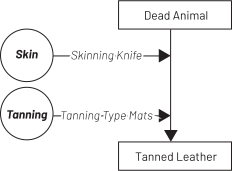
Leather comes from skinning an animal or from salvaging old leather gear. A hide becomes leather through tanning, and the tanning decides what kind of leather you get.
Tanning the hide#
Skin takes the hide with a skinning knife, and tan leather treats it with a reagent: hot water for boiled leather or suede, chromium sulfate for light and medium leather, glutaraldehyde for aniline, polymers for heavy leather and shell cordovan, aluminium salts for nubuck and shagreen, and lime salts for fur and nappa.
Making the piece#
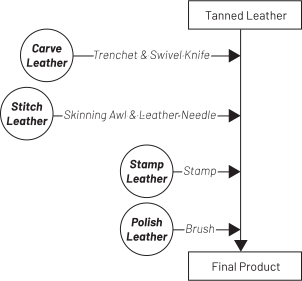
Carve leather cuts and shapes the tanned hide, stitch leather joins it, stamp leather tools a pattern into it and polish leather finishes it.
Skills and tools#
- ReconditionInquirer
- Recondition is used to fix minor problems in leather and cloth armor, turning fair or excellent condition items into mint condition.Tools: leather needle
- RepairHobbyist
- Repair is used to fix major problems in leather and cloth armor, turning damaged or mediocre condition items into fair condition items so they can then be reconditioned to mint.Tools: leather needle, patch
- RebuildApprentice
- Rebuild is used to completely overhaul broken or ruined condition leather and cloth armor into damaged condition items so they can be repaired and reconditioned back into pristine shape.Tools: leather needle, sewing table
- Skin
- Skins an animal to retain its hide for leatherworking.Tools: skinning knife
- Butcher
- Cuts a thick steak from the corpse of a beast with a skinning knife. Nothing more can be taken from the corpse once it is butchered, so skin it first.Tools: skinning knife
- Tan Leather
- Tans raw leather with specified tanning typeTools: tanning rack
- Carve Leather
- Uses a knife to carve a design into the leather. Increases the value of the item. Cannot be painted if carved.Tools: swivel knife
- Stitch Leather
- Using a leather needle, sew together leather into a specific design
- Stamp Leather
- Stamp the maker into the leather, increasing the value of the item.Tools: stamp
- Polish Leather
- Increases the value of the leather item.Tools: polishing cloth
Tools and supplies (19)
| Tool | What it is for |
|---|---|
| Stitching Awl | Required to poke holes within leather for the leather needle. |
| Trenchet | Used to trim leather. |
| Swivel Knife | Used to carve a design into leather. |
| Brush | An implement with a handle, consisting of bristles set into a block used for cleaning or scrubbing a surface. |
| Skinning Knife | Used to skin animals and gather leather. |
| Leather Lacquer | A liquid made of shellac dissolved in alcohol, or of synthetic substances, that dries to form a hard protective coating for wood. |
| Leather Needle | Used to sew leather together. |
| Stamp | An instrument for stamping a pattern or mark using ink or wax. |
| Hot Water | Used for vegetable tanning. |
| Chromium Sulfate | Used for chrome tanning, a teal chrystalline powder. |
| Gluteraldehyde | Used for aldehyde tanning, a strong-smelling white liquid. |
| Polymers | Used for synthetic tanning, a clear strong-smelling liquid. |
| Aluminium Salt | Used for alum tanning, a shiny silver powder. |
| Lime Salt | Used for rawhide tanning, a clumpy light green crystalline powder. |
| Bone Folder | A smooth, flat blade of polished bone used to crease, score and burnish leather and paper. |
| Beveler | A small edge tool with a grooved cutting tip, pushed along the edge of leather to round off and bevel its corner. |
| Tanning Rack | A wooden frame a raw hide is stretched and pegged on to be worked and dried into leather. |
| Patch | A patch is a roll of stout cloth scraps that tailors and leatherworkers cut from and sew over tears and worn spots, with a needle, to repair cloth and leather armor. |
| Sewing Table | A sewing table is a broad, smooth table with a lip to keep the work from sliding. Tailors and leatherworkers lay a ruined garment flat across it to take it apart and rebuild it. |
What it makes#
Leathers#
Each leather comes from tanning a skinned hide with the reagent that makes it.
Leathers (13)
| Leather | DC | Tanning | Reagent | Description |
|---|---|---|---|---|
| Flesh | 5 | Tanned living flesh, warm to the touch, that seals its own cuts overnight. Only the most practiced crafters can work it, and armor made of it heals itself. | ||
| Fur | 10 | Soft and dense coat of hair atop an animal pelt. | ||
| Light Leather | 10 | Light leather is the basic, thinnest of applicable leather types for armor wear. | ||
| Skin | 10 | A furless skin of an animal or creature killed during hunt or combat, not yet tread and preserved. | ||
| Medium Leather | 15 | Medium leather is the most common of leather types and has a thickness between light and heavy. | ||
| Nubuck | 15 | The leather has a soft and rough surface and is made prediminately for shoes. | ||
| Shell Cordovan | 15 | Shell cordovan is a fine soft leather originally made from goatskin, but now popularly and predominately made from horsehide or other rare animals and creatures. It may be fine and soft, but is incredibly resilient. | ||
| Suede | 17 | Suede is made with the flesh side turned outward and rubbed up to make a velvety nap. Suede is more cosmetic than resilient, and is difficult to make though skins are easy to acquire in nature. | ||
| Aniline Leather | 18 | Aniline is a colorless and poisonous liquid used to shine and strengthen normal leather. The leather after shined becomes hard to bend, but gains greater tensil strength. | ||
| Boiled Leather | 18 | Boiled leather is difficult to stitch but offers great protection from a variety of attacks and elements. It is considered a step above heavy leather in usefulness. | ||
| Nappa Leather | 18 | Nappa leather was originally made from sheeps skin, but since has been found on rare magical creatures. The soft leather is very durable and incredibly sought after because of its unique colors. | ||
| Shagreen | 18 | A rough skin usually found on some sharks, stingrays and magical creatures. This is used as an abrasive or hard and incredibly protective leather if treated properly. | ||
| Heavy Leather | 20 | Heavy leather is the thickest of common leather types. It offers the most protection for the amount of money it costs. |
What a leatherworker makes#
Weapons (1)
| Piece | DC | Material |
|---|---|---|
| Whip | 10 | 30 leather |
Armor (15)
| Piece | DC | Material |
|---|---|---|
| Arm-Guards | 8 | 6 metal and leather |
| Armband | 8 | 6 cloth and leather |
| Bracers | 8 | 7 metal and leather |
| Leggings | 8 | 20 leather |
| Belt | 10 | 10 leather |
| Boots | 10 | 10 metal and leather |
| Gloves | 10 | 8 leather and cloth |
| Moccasin | 10 | 15 leather |
| Mantle | 11 | 15 cloth and leather |
| Splint Leggings | 13 | 44 metal and leather |
| Tunic | 13 | 35 leather and cloth |
| Splint Boots | 14 | 83 metal and leather |
| Splintmail | 14 | 81 metal and leather |
| Studded Tunic | 15 | 32 leather |
| Splint Shoulders | 20 | 56 metal and leather |
Tools (1)
| Piece | DC | Material |
|---|---|---|
| Bone Folder | 4 | 1 bone |
Containers and packs (4)
| Piece | DC | Material |
|---|---|---|
| Waterskin | 5 | 10 leather |
| Saddlebag | 15 | 45 cloth and leather |
| Satchel | 18 | 35 cloth and leather |
| Backpack | 20 | 40 cloth and leather |
Everything else (7)
| Piece | DC | Material |
|---|---|---|
| Saddle | 6 | 20 leather |
| Snaffle Bridle | 10 | 23 leather |
| Timbrel | 10 | 5 wood, 3 metal and 2 leather |
| Pelham Bridle | 11 | 22 leather |
| Western Bridle | 12 | 24 leather |
| Weymouth Bridle | 13 | 22 leather |
| Parkhorse Bridle | 15 | 21 leather |
The guildmaster#
Tavo spent forty years in the tanning yards downwind of Esthar’s Inner City, insisting the smell was honest work. Half the Maygonites in Esthar wear his boots into the ruins, and he has outlived more of his customers than any tradesman in the province. He came to Verinton for the deer hides the Carvi still smoke the old way, and stayed in a deer-hide tent because nobody there minds the smell.
Find Tavo Rennick at a deer-hide tent in Verinton, in Amari. It’s the guild’s only hall: you join there, and you come back to it for every rank’s quest, inquirer to artisan.
Trades it works with#
What leatherworking gives the other trades.
 Animal Husbandry
Bridles and saddles, and everything else a rider straps onto a mount.
 Carpentry
Leather for upholstered chairs, sofas and thrones.
 Tailoring
Leather trim and backing for armor that's part cloth, part hide.
What it takes from them.
A good pair
Tailoring: Between them they make every piece of armor that isn’t metal, and the packs to carry the rest.
Animal Husbandry: Break the horse, then make its saddle and bridle yourself.
Who takes it up#
The classes whose work leatherworking fits best. Any class can join any guild.
 Headhunter
s fight from the shadows, and leather armor doesn't clank.
 Woodsman
A woodsman hunts anyway. Leatherworking turns every kill into boots, armor and coin.
 Scout
Scouts travel light and fast, and leather is the lightest armor that still turns a blade.
 Gravedigger
s aren't squeamish, which is most of what skinning takes.
The guild finder ranks every guild for a class.
How it shows#
None of this changes a roll. It’s how the people around you can tell what you do for a living.
- You smell faintly of tannin however often you wash, and dogs follow you.
- You run your thumb along the seams of anything leather you’re handed, and frown if the stitching wanders.
What others say#
I've worn Rennick's boots into four tombs and out of three. The fourth time I left them behind and ran barefoot.
You always know where the leatherworkers live. Follow your nose and keep walking.
The hide that wasn’t
A hunter sold Tavo Rennick a hide he swore came from a lion, and everything made from it is going wrong: boots that walk their wearers into the ruins at night, a belt that won’t stop tightening. The hunter has disappeared into the Lien Grassland, and Tavo needs to know what the animal really was before he sells another piece.