Mining#

Listen to the rock before you hit it. It tells you where it wants to break, and it only tells you once.
The trade of ore, stone and the gems inside them. Miners dig what every forge on Sedia burns through, smelt it into ingots and blocks, and crack the odd stone open for whatever is hiding in it.
Ranks and quests#
The guild’s hall sets each rank’s quest. Six ranks has what every rank makes, and making something how the craft roll works.
- Level0Rank 1: Inquirer
Trash to Shoddy · ×1 worth · 1d6 craft roll
Haul ore carts in the hall's cuts for a week without losing one down a shaft.
- Level20Rank 2: Hobbyist
Crude to Inferior · ×1.25 worth · 2d6 craft roll
Bring up a full cart from a deposit you found yourself.
- Level40Rank 3: Apprentice
Shoddy to Acceptable · ×1.5 worth · 2+3d6 craft roll
Smelt a block of iron clean enough that the hall finds no slag when it breaks it open.
- Level60Rank 4: Journeyman
Poor to Fine · ×1.75 worth · 4+4d6 craft roll
Open a deposit in the Iron Sands of Moria and bring back what it gives, before the heat or the creatures take you.
- Level80Rank 5: Master
Inferior to Flawless · ×2 worth · 5+5d6 craft roll
Prospect a gem worth more than the cart of ore it came out of, from ore you mined yourself.
- Level100Rank 6: Artisan
Adequate to Masterwork · ×3 worth · 6+6d6 craft roll
Find a vein nobody has mapped, in the deep under Narsis or the mountains of Jewall, and bring the guild a sample and the way back to it.
The work#
Mining starts in the wild, at a deposit. Identify ore before you swing at it: a miner who doesn’t know what they’re hitting shatters more than they keep. Mine ore takes it, and the better your rank, the more a deposit gives you and the likelier a side product comes with it.
Ore is cast into ingots (5 material) or blocks (100 material, the same as 20 ingots), or spent on prospect ore, which breaks it down in search of gems.
Melting the ore#
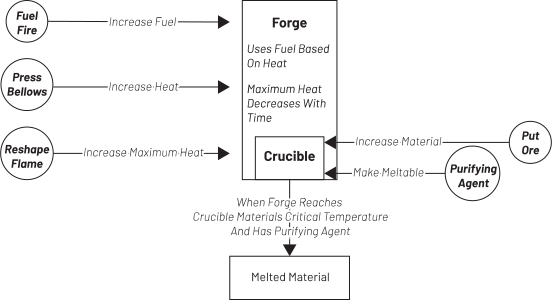
Smelt ore in a crucible heated to the ore’s melting point. Press bellows drives the heat up, fuel fire feeds the coal, and reshape flame rebuilds the fire when the forge can’t reach the heat it used to. Ore won’t melt clean even at its melting point without a reducing agent to pull the slag out of it.
Casting ingots and blocks#
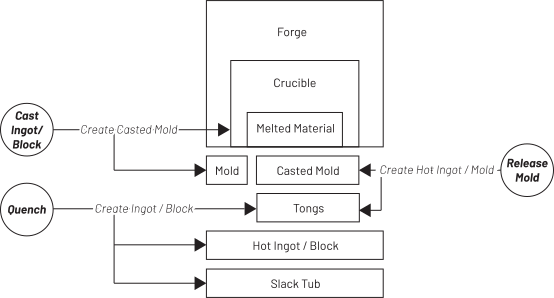
Cast ingot or cast block pours the melt into a mold. Once it sets, release mold frees the hot metal and quench cools it in the slack tub. Ingots go to blacksmiths, blocks go into storage, and both sell.
Skills and tools#
- Mine Ore
- Mine ore from a deposit using a mining pick.Tools: mining pick
- Identify Ore
- Identifies the type of a specified ore.
- Prospect Ore
- Prospects ore and retrieves valuable minerals and gems.Tools: mining pick
- Smelt Ore
- Uses a reducing agent to smelt the ore into a melted form producing slag as a byproduct, forge or hearth, reducing agent and ore in the crucible.Tools: forge, crucible
- Fuel Fire
- Issues coal into a hearth or forge.
- Press Bellows
- Increases the heat of the hearth or forge by forcing air into it (forge) or upon it (hearth) through a tuyere.
- Reshape Flame
- Increases the maximum heat potential by assembling a new layer of damp coal around the edge of the hearth or forge.
- Cast Ingot
- Pour pure melted metal (req 5) from a crucible into an ingot mold.
- Cast Block
- Pour pure melted metal (req 100) from a crucible into an block mold.
- Release Mold
- After the melted metal cools into a solid, releasing a mold clears the hot raw product from the mold making it ready for quenching.
- Quench
- Done immediately after releasing a mold quenching dumps the hot raw product into a slack tub so it can be swagged.
| Tool | What it is for |
|---|---|
| Ingot Mold | An ingot mold is used to cast molten purified ore into ingots so that blacksmiths can use the ingots for producing items. The process of purifying ore is through smelting it. |
| Block Mold | A block mold is used to cast molten purified ore into blocks so that blacksmiths can consolidate materials. A block is essentially 20 ingots in material amount. |
| Reducing Agent | Used to smelt ores into metals. It helps purify the metal by separating the pure metal from the oxides and other unwanted extracts called slag. |
| Mining Pick | Pick used to retrieve ore from a deposit. |
| Slag | When forging weapons, the molten cast material, either ingot or mold has a tendency to develop slag deposits if there is too much inconsistency in the material. Slag degrades the quality of the item being created, giving it rough or brittle sections. Slag may be compared to knots in wood. |
| Slack Tub | Tub of cool water used to extinguish heat from hot metals after they’re done being cast. |
| Forge | Helps in heating of materials contained as ingots into molds by melting them into a liquid state. |
| Hearth | Very similar to a forge, a hearth is a smaller version where the crucible actually sets ontop instead of within. A hearth heats up to melt the material within the crucible. |
| Tuyere | Item used to breathe air into a hearth or forge to increase the heat. |
| Tongs | Tongs are metallic tools that bend at the top apex, allowing the tips to clamp and surface with the continued force of squeezing the handles together. Tongs are used to hold very hot items, predominately those that need to be transported to the quench tank to cool. |
What it makes#
Deposits#
How much ore a deposit holds, and how often you find one that size.
| Deposit | Ore | Chance |
|---|---|---|
| Minor | 1 to 3 | 35% |
| Small | 4 to 8 | 37% |
| Mediocre | 9 to 12 | 17% |
| Large | 13 to 16 | 7% |
| Gargantuan | 17 to 20 | 1% |
Each time you mine, roll for a bonus: extra ore, and side products with it.
| Bonus | Extra ore | Side products | Chance |
|---|---|---|---|
| None | +0 | 0 | 69% |
| Minor | +1 | 1 | 11% |
| Small | +2 | 1 | 5% |
| Mediocre | +3 | 2 | 5% |
| Large | +4 | 2 | 5% |
| Gargantuan | +5 | 3 | 5% |
Ore#
Ore (46)
| Ore | DC | Where | Description |
|---|---|---|---|
| Antimony | 5 | canyon, mountain, arctic tundra, antarctic tundra, fellfield tundra, park tundra, alpine tundra, closed forest taiga, lichen woodland taiga, montane grassland, chalk heathland, bolster heathland, chaparral heathland | A mundane element. |
| Argentite | 5 | canyon, mountain, arctic tundra, antarctic tundra, fellfield tundra, park tundra, alpine tundra, closed forest taiga, lichen woodland taiga, montane grassland, chalk heathland, bolster heathland, chaparral heathland | A dark lead-grey ore, soft enough to cut with a knife, that blackens further the longer it sits in the light. Smelted down, it gives up the silver that goes into billon. |
| Bauxite | 5 | canyon, mountain, arctic tundra, antarctic tundra, fellfield tundra, park tundra, alpine tundra, closed forest taiga, lichen woodland taiga, montane grassland, chalk heathland, bolster heathland, chaparral heathland | Rust-red earthy rock packed with small round pellets, more like baked clay than stone. Smelters render it into aluminium, duralumin and alnico. |
| Beryl | 5 | canyon, mountain, arctic tundra, antarctic tundra, fellfield tundra, park tundra, alpine tundra, closed forest taiga, lichen woodland taiga, montane grassland, chalk heathland, bolster heathland, chaparral heathland | Six-sided crystals of pale green and sea blue, grown into the host rock like a bundle of pencils. Most of it goes to the smelter for aluminium and silumin rather than to a jeweler. |
| Bornite | 5 | carpathian forest, boreal forest, montane shrubland, giant sequoia forest, douglas fir forest, sitka spruce forest, coastal redwood forest, alerce forest, tropical forest, subtropical forest, temperate forest, mediterranean forest, mediterranean woodland, kauri forest, badlands, mediterranean savanna, mediterranean shrubland, cactus shrubland, mediterranean grassland, tropical broadleaf forest, subtropical broadleaf forest, bosque, riparian forest, garrigue hills, moorland, shrubland, coastal plain, maquis shrubland, prairie, highland plateau, veldt, machair, cerrado savanna, xeric shrubland, hamada desert, regs desert, ergs desert, sagebrush steppe | Copper ore that tarnishes to a purple, blue and red sheen, which is why miners call it peacock ore. Smelters turn it into tombac and tumbaga. |
| Boron | 5 | canyon, mountain, arctic tundra, antarctic tundra, fellfield tundra, park tundra, alpine tundra, closed forest taiga, lichen woodland taiga, montane grassland, chalk heathland, bolster heathland, chaparral heathland | A mundane element. |
| Carnallite | 5 | bayou, wetland fen, valley bog, raised bog, freshwater swamp forest, blanket bog, peat swamp forest, dambo swamp, mangrove swamp, fynbos, water meadow, hot spring geyser, pond, hot spring | Soft, glassy crystals of white and rust-red, scraped from the crusts around hot springs and drying ponds. It tastes bitter, and left in damp air it slowly turns to brine. |
| Celadonite | 5 | hydrothermal vent, cavern, anchialine cave, fissure vent, shield volcano, lava dome, cryptodome, mud volcano | Soft blue-green earth that fills the gas pockets in volcanic rock. Ground fine, it makes a muted green pigment that painters call green earth. |
| Chalcocite | 5 | carpathian forest, boreal forest, montane shrubland, giant sequoia forest, douglas fir forest, sitka spruce forest, coastal redwood forest, alerce forest, tropical forest, subtropical forest, temperate forest, mediterranean forest, mediterranean woodland, kauri forest, badlands, mediterranean savanna, mediterranean shrubland, cactus shrubland, mediterranean grassland, tropical broadleaf forest, subtropical broadleaf forest, bosque, riparian forest, garrigue hills, moorland, shrubland, coastal plain, maquis shrubland, prairie, highland plateau, veldt, machair, cerrado savanna, xeric shrubland, hamada desert, regs desert, ergs desert, sagebrush steppe | A dark grey copper ore with a dull, sooty face that leaves a black smudge on the fingers. It is one of the richest copper ores a miner can find. |
| Chalcopyrite | 5 | carpathian forest, boreal forest, montane shrubland, giant sequoia forest, douglas fir forest, sitka spruce forest, coastal redwood forest, alerce forest, tropical forest, subtropical forest, temperate forest, mediterranean forest, mediterranean woodland, kauri forest, badlands, mediterranean savanna, mediterranean shrubland, cactus shrubland, mediterranean grassland, tropical broadleaf forest, subtropical broadleaf forest, bosque, riparian forest, garrigue hills, moorland, shrubland, coastal plain, maquis shrubland, prairie, highland plateau, veldt, machair, cerrado savanna, xeric shrubland, hamada desert, regs desert, ergs desert, sagebrush steppe | Brassy yellow ore that new miners mistake for gold until it shatters under the hammer. Smelters draw the copper from it for brass and shakudo. |
| Chromite | 5 | canyon, mountain, arctic tundra, antarctic tundra, fellfield tundra, park tundra, alpine tundra, closed forest taiga, lichen woodland taiga, montane grassland, chalk heathland, bolster heathland, chaparral heathland | Heavy black ore with a greasy, metallic shine. It is the only source of chromium, and a sack of it is worth carrying out of the mountains. |
| Cinnabar | 5 | canyon, mountain, arctic tundra, antarctic tundra, fellfield tundra, park tundra, alpine tundra, closed forest taiga, lichen woodland taiga, montane grassland, chalk heathland, bolster heathland, chaparral heathland | A purifying agent. |
| Cobaltite | 5 | canyon, mountain, arctic tundra, antarctic tundra, fellfield tundra, park tundra, alpine tundra, closed forest taiga, lichen woodland taiga, montane grassland, chalk heathland, bolster heathland, chaparral heathland | Silvery cubes of ore with a faint pink cast. Heated, it gives off a garlic stink of arsenic, so miners roast it outdoors. |
| Colbatite | 5 | canyon, mountain, arctic tundra, antarctic tundra, fellfield tundra, park tundra, alpine tundra, closed forest taiga, lichen woodland taiga, montane grassland, chalk heathland, bolster heathland, chaparral heathland | Grey ore crusted with a crimson-pink bloom that comes off on the fingers. It is the ore cobalt, stellite and vitallium come from. |
| Coltan | 5 | carpathian forest, boreal forest, montane shrubland, giant sequoia forest, douglas fir forest, sitka spruce forest, coastal redwood forest, alerce forest, tropical forest, subtropical forest, temperate forest, mediterranean forest, mediterranean woodland, kauri forest, badlands, mediterranean savanna, mediterranean shrubland, cactus shrubland, mediterranean grassland, tropical broadleaf forest, subtropical broadleaf forest, bosque, riparian forest, garrigue hills, moorland, shrubland, coastal plain, maquis shrubland, prairie, highland plateau, veldt, machair, cerrado savanna, xeric shrubland, hamada desert, regs desert, ergs desert, sagebrush steppe | Dull black ore, far heavier in the hand than its size suggests. Miners prize it in the forest diggings, though few smelters know what to do with it. |
| Corderoite | 5 | primary cave, surface mine, sub-surface mine, fracture cave, talus cave, erosional cave, glacier cave | Pinkish-orange crystals that slowly darken toward black when left in the light. Smelters use it to make lignite. |
| Cylindrite | 5 | canyon, mountain, arctic tundra, antarctic tundra, fellfield tundra, park tundra, alpine tundra, closed forest taiga, lichen woodland taiga, montane grassland, chalk heathland, bolster heathland, chaparral heathland | Dark grey ore that grows in rolled sheets, like tiny scrolls of metal packed into the rock. It is soft enough to peel with a fingernail. |
| Galena | 5 | canyon, mountain, arctic tundra, antarctic tundra, fellfield tundra, park tundra, alpine tundra, closed forest taiga, lichen woodland taiga, montane grassland, chalk heathland, bolster heathland, chaparral heathland | A purifying agent |
| Garnierite | 5 | canyon, mountain, arctic tundra, antarctic tundra, fellfield tundra, park tundra, alpine tundra, closed forest taiga, lichen woodland taiga, montane grassland, chalk heathland, bolster heathland, chaparral heathland | Soft apple-green ore that stains the hands. It is smelted for nickel, nichrome and stellite. |
| Granite | 5 | primary cave, surface mine, sub-surface mine, fracture cave, talus cave, erosional cave, glacier cave | Hard, speckled stone of pink, grey and black grains, heavy to haul out of the caves. Masons use it for foundations, steps and anything meant to outlast its builder. |
| Grey Clay | 5 | canyon, mountain, arctic tundra, antarctic tundra, fellfield tundra, park tundra, alpine tundra, closed forest taiga, lichen woodland taiga, montane grassland, chalk heathland, bolster heathland, chaparral heathland | Grey clay is used to form earthenware, a special form of pottery which is resistant to damage and porous in nature. |
| Hematite | 5 | canyon, mountain, arctic tundra, antarctic tundra, fellfield tundra, park tundra, alpine tundra, closed forest taiga, lichen woodland taiga, montane grassland, chalk heathland, bolster heathland, chaparral heathland | A black gem |
| Ilmenite | 5 | carpathian forest, boreal forest, montane shrubland, giant sequoia forest, douglas fir forest, sitka spruce forest, coastal redwood forest, alerce forest, tropical forest, subtropical forest, temperate forest, mediterranean forest, mediterranean woodland, kauri forest, badlands, mediterranean savanna, mediterranean shrubland, cactus shrubland, mediterranean grassland, tropical broadleaf forest, subtropical broadleaf forest, bosque, riparian forest, garrigue hills, moorland, shrubland, coastal plain, maquis shrubland, prairie, highland plateau, veldt, machair, cerrado savanna, xeric shrubland, hamada desert, regs desert, ergs desert, sagebrush steppe | Black, weakly magnetic grains and lumps that cling a little to a lodestone. It is the ore titanium is drawn from. |
| Limonite | 5 | canyon, mountain, arctic tundra, antarctic tundra, fellfield tundra, park tundra, alpine tundra, closed forest taiga, lichen woodland taiga, montane grassland, chalk heathland, bolster heathland, chaparral heathland | Crumbly yellow-brown rock the color of old rust, sometimes dug as bog iron. Smelters turn it into nickel, invar and chromel. |
| Magnetite | 5 | canyon, mountain, arctic tundra, antarctic tundra, fellfield tundra, park tundra, alpine tundra, closed forest taiga, lichen woodland taiga, montane grassland, chalk heathland, bolster heathland, chaparral heathland | Black iron ore that pulls at nails and makes a compass needle swing. Miners find it in mountains, canyons and the cold northern ground. |
| Malachite | 5 | carpathian forest, boreal forest, montane shrubland, giant sequoia forest, douglas fir forest, sitka spruce forest, coastal redwood forest, alerce forest, tropical forest, subtropical forest, temperate forest, mediterranean forest, mediterranean woodland, kauri forest, badlands, mediterranean savanna, mediterranean shrubland, cactus shrubland, mediterranean grassland, tropical broadleaf forest, subtropical broadleaf forest, bosque, riparian forest, garrigue hills, moorland, shrubland, coastal plain, maquis shrubland, prairie, highland plateau, veldt, machair, cerrado savanna, xeric shrubland, hamada desert, regs desert, ergs desert, sagebrush steppe | A bright green mineral consisting of copper hydroxyl carbonite |
| Mangalium | 5 | canyon, mountain, arctic tundra, antarctic tundra, fellfield tundra, park tundra, alpine tundra, closed forest taiga, lichen woodland taiga, montane grassland, chalk heathland, bolster heathland, chaparral heathland | A dark metal mined in native veins that needs no smelting. The ingots stay warm in the hand, and melee weapons forged from it carry a lick of fire. |
| Marble | 5 | primary cave, surface mine, sub-surface mine, fracture cave, talus cave, erosional cave, glacier cave | Pale stone with grey veins, quarried from cave walls and heavy to haul. Polished, it takes a high shine, and sculptors and builders pay well for clean blocks. |
| Molybdenite | 5 | canyon, mountain, arctic tundra, antarctic tundra, fellfield tundra, park tundra, alpine tundra, closed forest taiga, lichen woodland taiga, montane grassland, chalk heathland, bolster heathland, chaparral heathland | Soft, bluish-grey flakes that feel greasy and leave a grey line on paper like a pencil. It is the ore molybdenum is smelted from. |
| Orpiment | 5 | canyon, mountain, arctic tundra, antarctic tundra, fellfield tundra, park tundra, alpine tundra, closed forest taiga, lichen woodland taiga, montane grassland, chalk heathland, bolster heathland, chaparral heathland | A purifying agent. |
| Pegmatite | 5 | fissure vent, shield volcano, lava dome, cryptodome | Coarse volcanic rock built of crystals as big as a thumb, some far larger. Cracked and smelted, it yields chrysoberyl, alexandrite and cymophane. |
| Pentlandite | 5 | carpathian forest, boreal forest, montane shrubland, giant sequoia forest, douglas fir forest, sitka spruce forest, coastal redwood forest, alerce forest, tropical forest, subtropical forest, temperate forest, mediterranean forest, mediterranean woodland, kauri forest, badlands, mediterranean savanna, mediterranean shrubland, cactus shrubland, mediterranean grassland, tropical broadleaf forest, subtropical broadleaf forest, bosque, riparian forest, garrigue hills, moorland, shrubland, coastal plain, maquis shrubland, prairie, highland plateau, veldt, machair, cerrado savanna, xeric shrubland, hamada desert, regs desert, ergs desert, sagebrush steppe | Bronze-yellow ore with a metallic glint, common in the forest diggings. Smelters get steel, nickel, cupronickel and, rarely, palladium out of it. |
| Phosphorus | 5 | canyon, mountain, arctic tundra, antarctic tundra, fellfield tundra, park tundra, alpine tundra, lichen woodland taiga, montane grassland, closed forest taiga, chalk heathland, bolster heathland, chaparral heathland | A mundane element. Obtained from the bones of recently dead corporeal bodies. |
| Salt | 5 | canyon, mountain, arctic tundra, antarctic tundra, fellfield tundra, park tundra, alpine tundra, closed forest taiga, lichen woodland taiga, montane grassland, chalk heathland, bolster heathland, chaparral heathland | A prime. |
| Sphalerite | 5 | carpathian forest, boreal forest, montane shrubland, giant sequoia forest, douglas fir forest, sitka spruce forest, coastal redwood forest, alerce forest, tropical forest, subtropical forest, temperate forest, mediterranean forest, mediterranean woodland, kauri forest, badlands, mediterranean savanna, mediterranean shrubland, cactus shrubland, mediterranean grassland, tropical broadleaf forest, subtropical broadleaf forest, bosque, riparian forest, garrigue hills, moorland, shrubland, coastal plain, maquis shrubland, prairie, highland plateau, veldt, machair, cerrado savanna, xeric shrubland, hamada desert, regs desert, ergs desert, sagebrush steppe | A resinous brown-to-black zinc ore that throws back light like dark honey. Smelters work it for indium. |
| Stannite | 5 | carpathian forest, boreal forest, montane shrubland, giant sequoia forest, douglas fir forest, sitka spruce forest, coastal redwood forest, alerce forest, tropical forest, subtropical forest, temperate forest, mediterranean forest, mediterranean woodland, kauri forest, badlands, mediterranean savanna, mediterranean shrubland, cactus shrubland, mediterranean grassland, tropical broadleaf forest, subtropical broadleaf forest, bosque, riparian forest, garrigue hills, moorland, shrubland, coastal plain, maquis shrubland, prairie, highland plateau, veldt, machair, cerrado savanna, xeric shrubland, hamada desert, regs desert, ergs desert, sagebrush steppe | Steel-grey tin ore with an olive cast, sometimes called bell-metal ore. Smelters draw bismuth from it. |
| Stone | 5 | canyon, mountain, arctic tundra, antarctic tundra, fellfield tundra, park tundra, alpine tundra, closed forest taiga, lichen woodland taiga, montane grassland, chalk heathland, bolster heathland, chaparral heathland | A mundane element. |
| Sulfur | 5 | canyon, mountain, arctic tundra, antarctic tundra, fellfield tundra, park tundra, alpine tundra, closed forest taiga, lichen woodland taiga, montane grassland, chalk heathland, bolster heathland, chaparral heathland | A prime. |
| Sylvite | 5 | bayou, wetland fen, valley bog, raised bog, freshwater swamp forest, blanket bog, peat swamp forest, dambo swamp, mangrove swamp, fynbos, water meadow, hot spring geyser, pond, hot spring | Clear to pinkish salt cubes from the crusts around hot springs and ponds. It looks like table salt, but the taste is bitter and sharp. |
| Tan Clay | 5 | canyon, mountain, arctic tundra, antarctic tundra, fellfield tundra, park tundra, alpine tundra, closed forest taiga, lichen woodland taiga, montane grassland, chalk heathland, bolster heathland, chaparral heathland | Tan clay is used to create stonewear which is smooth and partially resistant to damage, a small amount more than earthenware pottery. |
| Telluride | 5 | primary cave, surface mine, sub-surface mine, fracture cave, talus cave, erosional cave, glacier cave | Pale, brittle metallic crystals mined deep in caves, often with gold or silver locked inside. Smelters work it for nickel. |
| Tellurium | 5 | primary cave, surface mine, sub-surface mine, fracture cave, talus cave, erosional cave, glacier cave | Silvery, brittle crystals dug from cave walls. Handle it too long and your breath smells of garlic for days; smelters use it to make lignite. |
| Uraninite | 5 | carpathian forest, boreal forest, montane shrubland, giant sequoia forest, douglas fir forest, sitka spruce forest, coastal redwood forest, alerce forest, tropical forest, subtropical forest, temperate forest, mediterranean forest, mediterranean woodland, kauri forest, badlands, mediterranean savanna, mediterranean shrubland, cactus shrubland, mediterranean grassland, tropical broadleaf forest, subtropical broadleaf forest, bosque, riparian forest, garrigue hills, moorland, shrubland, coastal plain, maquis shrubland, prairie, highland plateau, veldt, machair, cerrado savanna, xeric shrubland, hamada desert, regs desert, ergs desert, sagebrush steppe | Black, pitch-shiny ore that weighs nearly as much as lead. It is smelted into uranium and lignite, and miners do not like to sleep beside a sack of it. |
| White Clay | 5 | canyon, mountain, arctic tundra, antarctic tundra, fellfield tundra, park tundra, alpine tundra, closed forest taiga, lichen woodland taiga, montane grassland, chalk heathland, bolster heathland, chaparral heathland | White clay is used to form kaolinite, a special form of porcelain which is shiny and fragile. |
| Wolframite | 5 | canyon, mountain, arctic tundra, antarctic tundra, fellfield tundra, park tundra, alpine tundra, closed forest taiga, lichen woodland taiga, montane grassland, chalk heathland, bolster heathland, chaparral heathland | Dark brown-black crystals in flat blades, heavy for their size. Smelted, it goes into chromoly. |
| Zircon | 5 | kelp forest, sea cove, neritic zone, rocky shoreline, shingle beach, mudflat shoreline, sandy beach, estuary, river delta, shoal, benthic zone | A blue gem |
Gems#
Gems (42)
| Gem | DC | Description |
|---|---|---|
| Feldspar | 5 | A pink gem |
| Goshenite | 5 | A clear gem |
| Hematite | 5 | A black gem |
| Malachite | 5 | A bright green mineral consisting of copper hydroxyl carbonite |
| Sunstone | 5 | An orange gem, known for its strong ability battle potency. |
| Andalusite | 8 | A gold gem |
| Azurite | 8 | A deep blue precious gem known for appearing near copper. |
| Benitoite | 8 | A blue gem |
| Bixbite | 8 | A red gem |
| Chrysocolla | 8 | A blue gem |
| Chrysoprase | 8 | A green gem |
| Heliodor | 8 | A yellow gem |
| Jade | 8 | A hard, typically green stone used for ornaments and implements, consisting of the minerals jadeite or nephrite. |
| Jasper | 8 | An opaque reddish-brown variety of chalcedony. |
| Kunzite | 8 | Sometimes used as a purifying agent, but also a purple gem |
| Lapis Lazuli | 8 | A bright blue metamorphic rock consisting largely of lazurite. |
| Maxixe | 8 | A blue gem sometimes used as a purifying agent. |
| Moonstone | 8 | A multicolored precious gem commonly attributed to having magical properties. |
| Morganite | 8 | A pink gem |
| Olivine | 8 | A green gem |
| Onyx | 8 | A black gem |
| Opal | 8 | A bright multicolored rock consisting mostly of hydrated amorphous silica. |
| Pyrite | 8 | Used both as a purifying agent and as a red gem. |
| Sugilite | 8 | A purple gem |
| Tanzanite | 8 | A blue gem |
| Topaz | 8 | A precious pale blue stone consisting of fluorine containing aluminum silicate. |
| Turquoise | 8 | A blue gem |
| Zircon | 8 | A blue gem |
| Amethyst | 10 | A precious stone consisting of a violet or purple variety of quartz. |
| Aquamarine | 10 | A blue gem |
| Citrine | 10 | A yellow gem |
| Diamond | 10 | A clear gem |
| Emerald | 10 | A bright green precious stone consisting of a chromium-rich variety of beryl. |
| Garnet | 10 | A red gem |
| Golden Beryl | 10 | A yellow gem |
| Obsidian | 10 | A black material, sometimes used as a gem |
| Quartz | 10 | A semi-precious white crystalline gem. |
| Ruby | 10 | A precious stone consisting of corundum in color varieties usually reddish in hue. |
| Sapphire | 10 | A transparent precious stone, typically blue that is a variety of corundum. |
| Spinel | 10 | A precious stone consisting of corundum in color varieties usually reddish in hue. Known as a cheaper and more abundant version of ruby |
| Ammolite | 20 | A multi-colored gem |
| Tourmaline | 20 | A multi-colored gem |
Smelted metal#
Smelted metal (49)
| Metal | DC | Smelted from | Description |
|---|---|---|---|
| Agate | 5 | An ornamental stone consisting of a hard variety of chalcedonyl, typically banded in appearance. | |
| Alexandrite | 5 | A crystal from pegmatite that looks green by daylight and red by lamplight. Smiths set it into fittings, and fortune-tellers want it for the trick of the color. | |
| Alnico | 5 | A grey alloy of aluminium, nickel and cobalt that pulls iron filings into bristles. Weapons made of it hit with the weight of the earth behind them. | |
| Aluminium | 5 | A dull silver metal, light for its bulk, smelted from bauxite or beryl. It is soft and cheap, and most smiths alloy it before they forge with it. | |
| Arsenic | 5 | A mundane element. | |
| Billon | 5 | A dull silver-and-copper alloy that mints have struck coins from for generations. It is heavy, and gear made of it springs back from dents. | |
| Bismuth | 5 | A brittle metal that cools into stepped crystals with a rainbow skin of pink, gold and blue. Weapons made of it strike at the spirit. | |
| Brass | 5 | A bright yellow alloy of copper and zinc, smelted from chalcopyrite, light and cheap. It turns up in buckles, fittings and hinges, and it springs back from dents. | |
| Bronze | 5 | Copper and tin in a warm reddish-gold alloy, smelted from malachite. It is light and easy to cast, the metal of bells, statues and old weapons. | |
| Chromel | 5 | A nickel-chromium alloy with a dull, even shine. Armor made of it turns a little of every kind of elemental harm. | |
| Chromium | 5 | A hard metal that polishes to a mirror, smelted from chromite. It is very expensive, and armor made with it stands firm against earth magic. | |
| Chromoly | 5 | A hard, springy steel alloyed with chromium and molybdenum, smelted from wolframite. It is strong for its weight but does poorly in water. | |
| Chrysoberyl | 5 | Hard yellow-green crystal drawn out of pegmatite and worked like a metal. Smiths set it into hilts, rings and armor fittings. | |
| Cobalt | 5 | A hard, heavy metal with a faint blue tint, smelted from colbatite. It is cheap and takes water well, so it ends up in fittings and armor meant for wet work. | |
| Copper | 5 | A planetary metal. | |
| Cupronickel | 5 | A silvery copper-nickel alloy that salt water barely touches, which is why shipwrights use it for fittings. Armor made of it keeps out some of the sea’s harm. | |
| Cymophane | 5 | A honey-yellow crystal from pegmatite with a single bright band of light across it, like a cat’s eye. Jewelers and smiths pay well for clean pieces. | |
| Duralumin | 5 | Aluminium hardened with copper, still light but tough enough to hold an edge. Smiths smelt it from bauxite. | |
| Electrum | 5 | A planetary metal. | |
| Gallium | 5 | A soft silver metal that melts into a puddle if you hold it in your palm. It is useless near heat, and armor with gallium in it leaves the wearer badly exposed to fire. | |
| Gold | 5 | A planetary metal. | |
| Hepatizon | 5 | A dark bronze with gold and silver worked in, purple-black like raw liver. It is rare and expensive, and smiths save it for inlay and ornament. | |
| Indium | 5 | A very soft silver metal that squeaks when bent and leaves a mark on paper. Smelters draw it from sphalerite in small amounts. | |
| Invar | 5 | A grey nickel-iron metal that barely swells or shrinks with heat, which makes it useful for measuring rods and clockwork. It is light, and blades of it hit with a bit of earthen force. | |
| Iron | 5 | A planetary metal. | |
| Lead | 5 | A planetary metal. | |
| Lignite | 5 | Soft brown stuff, halfway between peat and coal, left over from smelting uraninite, tellurium and corderoite. Worked into armor, it makes the wearer very hard to burn. | |
| Magnesium | 5 | A mundane element. | |
| Mercury | 5 | A prime. | |
| Molybdenum | 5 | A heavy grey metal with a melting point higher than most forges can reach. It is expensive and slow to work, and armor made with it holds firm against earth magic. | |
| Nichrome | 5 | A nickel-chromium alloy that glows red in the forge long before it softens. Armor made of it stands up well to fire. | |
| Nickel | 5 | A silvery metal with a faint golden tinge that takes a good polish. Smelters get it from limonite, garnierite, pentlandite and telluride, and much of it goes into alloys. | |
| Palladium | 5 | A heavy, silver-white metal that never tarnishes, smelted in tiny amounts from pentlandite. It is one of the costliest metals there is, and armor made with it shrugs off air magic. | |
| Pewter | 5 | A planetary metal. | |
| Platinum | 5 | A mundane element. | |
| Potassium | 5 | A mundane element. | |
| Shakudo | 5 | A copper-gold alloy that a smith pickles to a blue-black sheen. Sword fittings and fine ornaments are made of it. | |
| Silumin | 5 | An aluminium alloy that pours easily into moulds and does not rust. Armor cast from it turns some water harm. | |
| Silver | 5 | A planetary metal. | |
| Steel | 5 | Plain grey steel smelted from pentlandite, the everyday metal of swords, tools and armor. It is cheap and heavy, and it does the job. | |
| Stellite | 5 | A cobalt-chromium alloy so hard it fights the smith’s file and hammer. Gear made from it springs back from damage that would ruin softer metal. | |
| Tin | 5 | A planetary metal. | |
| Titanium | 5 | A grey metal as strong as steel at half the weight, smelted from ilmenite. It is very expensive, and armor made with it turns aside spirit magic. | |
| Tombac | 5 | A brass so rich in copper that it passes for gold at a glance. Smiths make medals and gilt trim of it, and points of tombac punch through armor. | |
| Tumbaga | 5 | A gold-copper alloy whose surface the smith pickles until only the gold shows. It looks rich, but armor made of it leaves the wearer more open to spirit magic. | |
| Uranium | 5 | A dense silver metal that tarnishes black within days, smelted from uraninite. Weapons made of it strike hard at the spirit. | |
| Vitallium | 5 | A silvery alloy of cobalt, chromium and molybdenum that will not rust or pit. It gives armor a little protection against water. | |
| Zinc | 5 | A mundane element. | |
| Zirconium | 5 | A hard, grey-white metal smelted from zircon that shrugs off acid and rust. Armor made of it turns some earth magic. |
The guildmaster#
Vesk is a goblin who has worked the cuts under Narsis for sixty years and lost one finger to the rock in all that time, which she counts as a good record. Jewall’s Council of Forges buys her ore by the ton and never says where it came from, and she likes it that way. She has come up to the old dwarven adit on Bitterpeak to see what the Frostvein gives before the Council buys it, and she camps at the bothy out of the wind.
Find Vesk Ninefingers at the miners’ bothy at the Frost-Riven Adit, in Jewall. It’s the guild’s only hall: you join there, and you come back to it for every rank’s quest, inquirer to artisan.
Trades it works with#
What mining gives the other trades.
 Blacksmithing
Ingots and blocks, the metal of every weapon and piece of armor a smith makes.
 Jewelcrafting
Gold, silver and the gems prospecting turns up.
 Alchemy
The lead, tin, iron, copper, gold and silver fragments alchemy calls its planetary metals.
It takes nothing from the other trades: everything it works starts in the ground or the forest.
A good pair
Blacksmithing: Dig your own ore and smelt your own ingots, and your forge never sits cold waiting on a supplier.
Jewelcrafting: Prospecting turns up the gems a jeweler cuts, and the gold and silver to set them in.
Who takes it up#
The classes whose work mining fits best. Any class can join any guild.
 Plainsman
Plainsmen work with their backs, and a plainsman who digs their own ore never wants for a weapon.
 Page
Pages haul heavy armor all day, and a cart of ore is no worse.
 Woodsman
A woodsman already reads the land. Mining just reads what's under it.
The guild finder ranks every guild for a class.
How it shows#
None of this changes a roll. It’s how the people around you can tell what you do for a living.
- Your knuckles are scarred, and you knock on walls without thinking about it.
- You can tell iron from tin by the sound it makes under a hammer, and you say so out loud.
What others say#
The dwarves will tell you the best ore on Sedia comes out of Jewall. Ask them where Jewall buys its best ore, and watch them change the subject.
A miner's first lesson is that the ceiling is heavier than they are. The ones who skip it don't get a second.
The warm seam
Vesk’s crews broke into a seam under Narsis that is warm to the touch and getting warmer, and the ore it gives melts at half the heat it should. Two crews have refused to go back down. Jewall’s Council of Forges has already offered to buy every cart of it, sight unseen, and Vesk wants to know what they know before she sells.