Sigildry#

Glass remembers the breath that shaped it, and a sigil remembers the hand. Give them both something worth keeping.
The trade of glass, clay and sigils. Sigildry blows glassware and globes, throws pottery, paints the sigils that harden armor and assembles exotic armor from dragon scale, chitin and amber.
Ranks and quests#
The guild’s hall sets each rank’s quest. Six ranks has what every rank makes, and making something how the craft roll works.
- Level0Rank 1: Inquirer
Trash to Shoddy · ×1 worth · 1d6 craft roll
Keep the hall's kiln at heat through a night without cracking anything inside it.
- Level20Rank 2: Hobbyist
Crude to Inferior · ×1.25 worth · 2d6 craft roll
Blow a set of vials an alchemist will actually buy.
- Level40Rank 3: Apprentice
Shoddy to Acceptable · ×1.5 worth · 2+3d6 craft roll
Throw and fire a full table service, plates, bowls and pitcher, that matches.
- Level60Rank 4: Journeyman
Poor to Fine · ×1.75 worth · 4+4d6 craft roll
Identify every property of a magical item the hall has kept unnamed for years.
- Level80Rank 5: Master
Inferior to Flawless · ×2 worth · 5+5d6 craft roll
Paint a sigil on armor for someone walking into a fight, and be there to see it hold.
- Level100Rank 6: Artisan
Adequate to Masterwork · ×3 worth · 6+6d6 craft roll
Assemble a suit of exotic armor from scales you took yourself, from a creature the hall can name.
The work#
Sigildry works three materials. Glass is melted from sand or salvaged from old glassware, clay is thrown on a wheel, and exotic armor is assembled from scale, shell and resin.
A sigil goes on armor only and changes its armor class, and a piece carries one sigil at most. Identify magic reads every magical property of an item, its elements included.
Melting the glass#
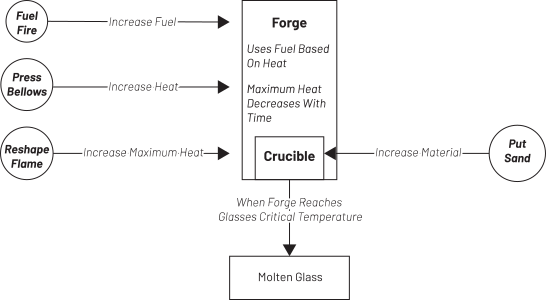
Heat sand in the crucible to its melting point with press bellows, fuel fire and reshape flame. Sand won’t melt into clear glass, even hot enough, without a purifying agent.
Blowing the glass#
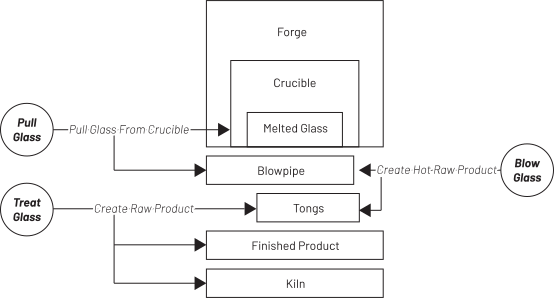
Pull glass draws molten glass from the crucible on a blowpipe, and blow glass shapes it as you turn the pipe. Treat glass then lets it cool slowly in a kiln. Cool it too fast and it shatters, or comes out brittle in places nobody can see.
Throwing clay#
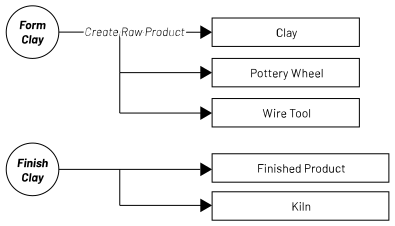
Clay is simpler. Shape it on the pottery wheel, cut it free with a wire tool and fire it in the kiln until it’s dry and hard.
Sigils and exotic armor#
Paint sigil puts a sigil on a piece of armor with a brush and paint. Exotic assembly binds scale, chitin or amber into armor with a sigil, and deduce mold makes a mold from an existing piece.
Skills and tools#
- ReconditionInquirer
- Recondition is used to fix minor problems in exotic arms and armor, turning fair or excellent condition items into mint condition.Tools: steel wool
- RepairHobbyist
- Repair is used to fix major problems in exotic arms and armor, turning damaged or mediocre condition items into fair condition items so they can then be reconditioned to mint.Tools: steel wool, refining solution
- RebuildApprentice
- Rebuild is used to completely overhaul broken or ruined condition exotic arms and armor into damaged condition items so they can be repaired and reconditioned back into pristine shape.Tools: blacksmith hammer, anvil
- Fuel Fire
- Issues coal into a hearth or forge.
- Press Bellows
- Increases the heat of the hearth or forge by forcing air into it (forge) or upon it (hearth) through a Tuyere.
- Reshape Flame
- Increases the maximum heat potential by assembling a new layer of damp coal around the edge of the hearth or forge.
- Pull Glass
- Pulls glass tub out of the forge and pours into the mold.
- Blow Glass
- Pushes air into the glass through the pipe forming the glass object.
- Treat Glass
- Finishes the glass form and destroys the rest of the clay mold.
- Identify Magic
- Identifies any magical item detailing its magical properties, including elemental properties.
- Deduce Mold
- Create a mold using an existing item, sand, forge and crucible
- Paint Sigil
- Use a brush and paint to create sigils of power
- Exotic Assembly
- Assemble exotic items together using a sigil
- Split Rune
- Splits a medium or large rune into small runes of its thread, a small rune for each step it held. A slip shatters the rune.
Tools and supplies (13)
| Tool | What it is for |
|---|---|
| Clay | Clay is molded by hand into respective shapes in the effort to create wax cut, or permanent molds. |
| Blowpipe | A blowpipe is a metallic hollow pipe used to push air into glass, allowing molten glass to expand into a shape. |
| Pottery Wheel | The pottery wheel is where clay forms are created before they are cut with a clay wire tool and moved to a kiln to be fired and finished. |
| Clay Wire Tool | The wire tool allows the sigildry tradesperson to cut a clay form from atop a pottery wheel so it can be moved to a kiln. |
| Blacksmith Hammer | Specialized hammer used within the blacksmithing tradesguild to form weapons, armor and other items. |
| Forge | Helps in heating of materials contained as ingots into molds by melting them into a liquid state. |
| Hearth | Very similar to a forge, a hearth is a smaller version where the crucible actually sets ontop instead of within. A hearth heats up to melt the material within the crucible. |
| Tongs | Tongs are metallic tools that bend at the top apex, allowing the tips to clamp and surface with the continued force of squeezing the handles together. Tongs are used to hold very hot items, predominately those that need to be transported to the quench tank to cool. |
| Mandrel | A tapered rod that rings and glass beads are shaped around. |
| Kiln | Used to treat glass by protecting it from rapidly cooling. |
| Brush | An implement with a handle, consisting of bristles set into a block used for cleaning or scrubbing a surface. |
| Acrylic Paint | Used to paint sigils onto armor, and to color leather. |
| Refining Solution | A refining solution is a sharp-smelling wash that lifts dings out of shell, bone, scale and pearl. Sigilists work it in with steel wool to repair exotic arms and armor. |
What it makes#
Glass#
Tools (6)
| Piece | DC | Material |
|---|---|---|
| Ampoule | 2 | 2 glass |
| Vial | 4 | 3 glass |
| Tube | 6 | 4 glass |
| Erlenmeyer Flask | 8 | 5 glass |
| Fleaker | 10 | 7 glass |
| Florence Flask | 10 | 6 glass |
Everything else (1)
| Piece | DC | Material |
|---|---|---|
| Spyglass | 10 | 4 glass |
Clay#
Cookware (4)
| Piece | DC | Material |
|---|---|---|
| Cooking Pot | 5 | 13 clay |
| Food Bowl | 5 | 13 clay |
| Food Plate | 5 | 7 clay |
| Kettle | 5 | 13 clay |
Everything else (5)
| Piece | DC | Material |
|---|---|---|
| Pipe | 10 | 8 clay |
| Whistle | 10 | 4 clay |
| Dice | 15 | 8 clay |
| Weighted Dice | 18 | 8 clay |
| Ocarina | 19 | 15 clay |
Exotic armor#
| Piece | DC | Material |
|---|---|---|
| Heater Shield | 10 | 61 exotic |
| Material | DC | Description |
|---|---|---|
| Millefiori | 10 | Slices of glass cane, each showing a tiny pattern of flowers, set side by side. It is a costly decoration, and weapons trimmed with it strike a little harder. |
| Sequin | 10 | Small, shiny metal discs stitched on in overlapping rows like fish scales. They make a garment flash in the light and turn a little elemental harm. |
| Chevron Beads | 15 | Glass beads built from layers of red, white and blue, ground at the ends to show a star pattern. They are cheap and common in trade. |
| Cinnabar Beads | 15 | Carved beads of red lacquer, colored with cinnabar and cut with tiny flowers and vines. A carver spends days on each one. |
| Amber | 20 | Fossil tree resin, golden and clear, sometimes with an insect caught inside. Small cracks in amber pieces seal themselves over, so gear made of it repairs itself. |
| Chitin | 20 | Hard, glossy plates of shell from giant insects, light and stiff. Assembled into armor, they turn blows as well as dragon scale and barely wear. |
| Dragon Scale | 20 | Overlapping scales from a dragon, each harder than steel plate and lighter than it looks. Armor made of them protects against nearly everything and almost never wears out. |
| Wyrm Scale | 25 | Scales from an ancient wyrm, thicker and darker than a dragon’s and harder still to assemble. Armor made of them protects against nearly everything and almost never wears out. |
The guildmaster#
Mother Sorn ran the kilns at Gilden for longer than most of its mages have been alive, and will teach anyone who can survive a winter there. The Exuvae bought her glass by the crate and asked her about sigils she wouldn’t paint. She told them she’d forgotten, which nobody believed. Now she keeps to the Primal Forge, where the First Artificer’s marks are cut into the stone rings, and reads them the way other people read letters.
Find Mother Ilka Sorn at the Primal Forge at Gilden, in New Saellem. It’s the guild’s only hall: you join there, and you come back to it for every rank’s quest, inquirer to artisan.
Trades it works with#
What sigildry gives the other trades.
 Alchemy
Vials, tubes, ampoules and flasks. The better a brew, the finer the glass it comes out in.
 Blacksmithing
Sigils for the armor a smith makes, and molds deduced from pieces nobody has a mold for.
What it takes from them.

A good pair
Alchemy: The better a brew, the finer the glass it needs, and sigildry blows it.
Who takes it up#
The classes whose work sigildry fits best. Any class can join any guild.
 Runescribe
A sigil is a rune's cousin. A runescribe reads both, and paints the one the other trades can't.
 Elementalist
s wade into fights wrapped in auras, and a sigil on their armor is one more layer between them and the blade.
 Mageling
Identify magic tells a mageling what an item does without a week in the library.
 Gravedigger
Plenty of what a gravedigger digs up is glass, clay or magical, and sigildry knows what to make of all three.
The guild finder ranks every guild for a class.
How it shows#
None of this changes a roll. It’s how the people around you can tell what you do for a living.
- Paint under your fingernails that never quite comes out, in colors nothing you own is dyed.
- You hold glass up to the light before you drink from it.
What others say#
Mother Sorn's glass rings like a bell when you tap it. Everyone else's just clinks.
A sigil on your breastplate won't stop a sword. It makes the sword miss more often, which I'll take.
The sigil she won’t paint
An Exuvae scholar has offered Mother Sorn a fortune for a sigil copied from the standing stones at Harrow Ridge, and she refused. Now her apprentices are being approached one by one, and one has already gone missing with a sketch. She wants the apprentice back before anyone paints that sigil on anything.